


AI in Lending | 6 min read
If you’ve ever applied for a loan, you know the drill. Fill out a lengthy form, gather a stack of documents, wait several days, and then receive a decision that feels more like a coin flip than a careful assessment of your finances. For millions of borrowers, it’s frustrating at best and financially damaging at worst.
But the problem isn’t just on the borrower’s side. Lenders are struggling too.
The Real Cost of Getting Underwriting Wrong
Traditional underwriting relies on a handful of data points like credit score, income, and employment history, along with a lot of manual judgment. Loan officers review files one by one, applying criteria that can vary from person to person. The result is a process that is slow, inconsistent, and full of blind spots.
Banks and NBFCs face a relentless tension: approve too many loans and default rates climb. Approve too few and you leave creditworthy customers behind while competitors step in. Neither outcome is sustainable.
“The biggest issue with traditional underwriting isn’t the people doing it. It’s the sheer volume, speed, and complexity of data that no human team can realistically process at scale.”
There’s also the fraud problem. Fraudulent applications have grown more sophisticated, slipping through manual checks and costing lenders significantly. And with increasing regulatory scrutiny, institutions need decisions that are consistent, documentable, and defensible — something hard to guarantee when approvals are made by hand.

Critical Gaps in the Current System
To understand why AI-powered underwriting matters, it helps to name what’s actually broken in the current system.
Slow turnaround is the most obvious issue. Loan decisions that should take seconds often take days, causing customers to drop off before an approval even comes through. Closely tied to this is decision inconsistency: two similar applicants reviewed by different officers can receive different outcomes, creating both fairness concerns and legal exposure.
High default rates follow when lenders rely on too few signals. Risky borrowers slip through while genuinely creditworthy ones are rejected. Fraud detection remains a weak spot as well, since manual review simply cannot catch the subtle behavioral patterns that indicate synthetic or fraudulent applications.
On top of all this, customers today expect instant answers from every service they use. A three-day loan decision feels antiquated when fintech alternatives are offering approvals in minutes.
Enter Underwrite IQ
Underwrite IQ is an AI-powered underwriting platform built to directly address these challenges. At its core, it uses XGBoost (Extreme Gradient Boosting), one of the most battle-tested machine learning algorithms available, alongside ensemble modeling techniques that layer multiple predictive signals to arrive at a comprehensive risk assessment.
Instead of reviewing five or six data points, Underwrite IQ processes hundreds of variables simultaneously: traditional credit data, transaction histories, utility payment patterns, alternative data sources, and macroeconomic context, all in the time it takes to load a webpage.
What This Looks Like in Practice
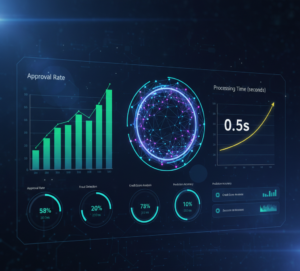
When an application comes in, Underwrite IQ collects and structures data from multiple sources, runs it through a feature engineering layer, and generates a risk score within approximately 2 to 3 seconds. The system then produces a decision recommendation along with a clear, human-readable explanation of why that decision was made.
That explainability piece matters more than it might seem. It is not just about transparency for the borrower. It is a regulatory requirement. Underwrite IQ is built to provide the audit trail and decision rationale that compliance teams need, right out of the box.
The platform also reaches borrowers who have thin or non-existent credit files, a segment that traditional underwriting routinely overlooks. By incorporating alternative data like mobile usage, digital wallet activity, and subscription payment history, Underwrite IQ builds a richer picture of creditworthiness, expanding access responsibly rather than simply lowering standards.
In terms of outcomes, institutions can expect prediction accuracy of approximately 95% in loan risk assessment, a reduction in portfolio default rates of up to 20 to 30%, and the ability to process upwards of 500 applications per minute without compromising performance.
Built for Lenders, Designed Around Compliance
Underwrite IQ is not a black box. Every decision comes with an explanation that satisfies fair lending requirements, and institutions can configure their own risk thresholds by product type, whether personal loans, business credit, or microfinance, to match their specific risk appetite.
The platform integrates with existing loan origination systems via API, so adoption does not require a wholesale overhaul of current infrastructure. And because the models retrain continuously on new outcomes, the system gets sharper over time rather than drifting out of date.
The Bottom Line
Lending has always been a data problem. The institutions that win have always been the ones who could read risk accurately at scale. For decades, that meant more analysts and bigger credit bureaus. Today, it means smarter systems.
Underwrite IQ is built on the belief that better data and better models can improve outcomes for lenders and borrowers at the same time. Lower defaults and higher approvals are not opposites when you get the risk assessment right.
“The goal was never to replace loan officers. It’s to give them a smarter, faster co-pilot — one that never gets tired, never gets biased, and never misses a signal.”
The question for lenders is not whether to adopt AI-powered underwriting. It is how quickly they can get there before the gap with early adopters becomes impossible to close.