

Fintech Infrastructure | 6 min read
Your Customers Notice When Onboarding Is Slow. Your Competitors Do Too.
In financial services, the onboarding experience is often the first real interaction a customer has with your institution. And in that moment, every extra step, every document re-submission, every “we’ll get back to you in 48 hours” is a signal not just about your process, but about your organization. The institutions winning customer relationships today are the ones who have made that first experience fast, frictionless, and trustworthy. The ones falling behind are still managing it through disconnected systems and manual workarounds. The gap between those two groups is largely an infrastructure gap. And it is entirely closable.
Why Your Onboarding Funnel Is Leaking
Most financial institutions underestimate how much drop-off happens between application and disbursal not because customers changed their minds, but because the process asked too much of them. Re-submitting KYC documents they have already submitted elsewhere. Waiting days for verification that should take seconds. Abandoning a mandate setup because the payment integration failed mid-flow.
Each of these friction points is a customer you spent money to acquire, walking away before they ever became revenue. And behind each friction point is an integration that wasn’t built to work seamlessly, a CKYC fetch that times out, an e-mandate that doesn’t support the customer’s preferred payment method, a bureau pull that requires a separate vendor touchpoint. The operational cost of managing these gaps falls on your team. The business cost falls on your bottom line.
“Every day your onboarding process asks customers to do something twice, wait longer than they should, or navigate a process that feels unfinished — is a day your competitors are converting the customers you’re losing.”
What Your Organization Actually Needs
The answer is not another point solution. Adding a fifth or sixth vendor to an already fragmented integration stack does not solve the problem, it deepens it. What institutions need is a single, reliable connection to all the essential financial infrastructure their operations depend on: CKYC, e-mandates, KYC verification across eKYC and CKYC formats, PAN verification, bureau fetch, bank account verification, GST, ITR, UAN, and eSign , all accessible through one platform, all maintained and compliant under one relationship.
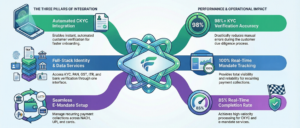
That is precisely what FinConnect delivers. It is a one-stop integration solution built for financial institutions that need to connect their systems to crucial financial infrastructure without the overhead of managing every integration separately. CKYC Integration gives your institution instant access to centralised KYC records with automated verification and updates, reducing operational costs and improving compliance without adding headcount. Additional Integration Services cover every verification and data touchpoint your lending or onboarding workflow requires. And E-Mandate Integration handles recurring payment collection across NACH, UPI, and cards with seamless mandate setup, real-time management, and instant transaction tracking built in.
The Numbers Your Operations Team Will Care About
When institutions ask what FinConnect actually delivers in production, the answer is measurable. CKYC fetch, e-mandate setup, and other financial service completions are achieved on a real-time basis at an 80 to 85% rate. KYC verification accuracy through automated systems runs at 98% or above which means fewer manual reviews, fewer errors, and fewer compliance exceptions for your team to manage. Payment integrations across NACH, UPI, and cards operate seamlessly within the same platform, eliminating the reconciliation complexity that comes with separate payment vendors. And mandate management and tracking runs at 100% real-time capacity, so your collections team always has instant visibility on every transaction status.
For an institution processing hundreds of applications a day, a meaningful reduction in manual verification touchpoints which combined with real-time mandate tracking across your entire portfolio represents a significant operational shift. Fewer exceptions, faster disbursal, and a collections process that requires less intervention to run reliably.
What This Means for Your Customer Relationship
The operational benefits translate directly into customer experience and customer experience translates directly into retention and conversion. When your onboarding takes minutes instead of days, customers associate that speed with your brand. When payment mandates are set up seamlessly and collections happen without friction, the relationship stays positive rather than becoming adversarial at the first EMI. The organization that invests in getting their infrastructure right are not just reducing costs. They are building the kind of customer experience that earns trust early, reduces churn, and creates the conditions for cross-sell and upsell that compound over the lifetime of the relationship. Infrastructure is invisible when it works. That invisibility is exactly what your customers are expecting.
The Bottom Line
Financial institutions that are growing are the ones that have stopped treating integration infrastructure as a back-office problem and started treating it as a competitive advantage. Fast, accurate, seamlessly connected onboarding and payment systems are not a nice-to-have, they are the baseline your customers now expect, and your regulators increasingly require.
FinConnect brings CKYC, e-mandates, KYC verification, bureau data, bank account validation, and additional financial integrations together under one robust, secure, and efficient platform — so your teams can focus on serving customers rather than managing systems.
“The institutions that onboard fastest, verify most accurately, and collect most reliably don’t just run better operations. They win more customers and keep them longer.”
See what seamless integration looks like for your organization. Request a demo of FinConnect today.